
Last Updated: November 14, 2026
Quick Summary
Yes, quality indoor cat accessories are worth it, because indoor cats depend on their home for enrichment, rest, and safe daily use. Focus on five essentials: food and water, litter, a scratching surface, a resting place, and play items. Choose each by your cat's age and your household layout, not price alone.
- Litter box length should be about one and a half times the cat's body length.
- Scratching posts should be at least as tall as the cat standing on its hind legs.
- Check toys for small detachable parts and loose strings, and replace any with frayed parts.
- Rotate toys every week or two so the collection stays interesting to the cat.
- Judge online products by named materials, dimensions, care instructions, and return terms.
Table of Contents
- What Indoor Cats Actually Need from Their Accessories
- A Practical Cat Supplies List for Indoor Homes
- Toys, Scratchers, and Furniture: Where Quality Shows Up Most
- Unique Cat Accessories Worth Considering Beyond the Basics
- How to Judge Quality Before You Buy Online
- Choosing a Best Online Cat Store Without Guessing
- Building an Indoor Cat Setup That Lasts: Your Next Step
- Frequently Asked Questions
What Indoor Cats Actually Need from Their Accessories
Indoor cats depend on their home for everything, so the quality of their indoor cat accessories matters more than most owners realise. Roughly 95 million U.S. households own a pet, according to the 2025 National Pet Owners Survey cited in APPA's 2026 State of the Industry Report, and a growing share of those homes are cat households.
Here is the core question: do cheap accessories fail indoor cats, or does price not predict much? The research supports a practical answer. Indoor cats need enrichment, comfortable resting places, and safe surfaces they can use every day.
At Dust and Iron, we look at accessories through three questions: does it engage the cat, does it hold up to daily use, and is it safe to leave unsupervised? Those questions shape everything below.
A Practical Cat Supplies List for Indoor Homes
A workable starter list covers five categories: food and water, litter, a scratching surface, a resting place, and play items. Each one affects daily comfort, so skimping on any of them tends to show up quickly. What most roundups miss is that the right version of each item depends on the cat and the home, not just the category.
Here is what most indoor homes need, with the variables that actually change the pick:
- Feeding bowls: Wide, shallow bowls reduce whisker fatigue and spills. A raised or tilted bowl helps seniors and cats with arthritis avoid neck strain. Slow feeders suit cats that eat too fast, but avoid them for cats with dental pain.
- Litter box: Choose one large enough for the cat to turn around in, a common rule is about one and a half times the cat's body length, with sides low enough to step over easily, since the right indoor cat accessories fit the cat's body, not just the room. Seniors and kittens do better with low-entry boxes; multi-cat homes need one box per cat plus one.
- Scratching post: Sisal-wrapped posts tall enough for a full stretch (at least as tall as the cat standing on hind legs) and stable enough not to wobble. Provide both vertical and horizontal options, because cats have individual preferences.
- Resting spots: A cat bed or elevated perch near a window. Washable covers matter more than filling type; firm support helps older cats, while kittens do fine with softer beds.
- Interactive toys: Wand toys for daily play sessions, plus a few simple items to leave out. Rotate them so the collection stays novel.
- ID tag and collar: A breakaway collar with an engraved tag, even for indoor cats, because doors and windows do get left open.
Litter needs a caveat. Check product labels and choose litters whose ingredients and dust levels you have verified yourself.
Tailoring the List by Cat and Household
The same five categories look different depending on who lives there. A few common patterns:
- Kittens: Prioritise low-entry litter boxes, sturdy scratchers they can climb, and toys sized for small mouths. Avoid anything with small detachable parts.
- Seniors and cats with mobility needs: Low-sided boxes, raised bowls, ramps or steps to favourite perches, and beds with firm support and easy access.
- Multi-cat homes: Duplicate resources, boxes, bowls, resting spots, and place them in separate areas so one cat cannot guard them all.
- Small apartments: Vertical space does the work of square footage. Wall-mounted shelves, window perches, and tall cat trees add usable territory without taking floor space.
- High-energy cats: More hunting-style play and puzzle feeders; less emphasis on static beds.
Matching the accessory to the cat's age and household layout helps avoid buying a good product that the cat never uses.
Toys, Scratchers, and Furniture: Where Quality Shows Up Most
Quality differences are most visible in the items cats use daily: toys, scratchers, and furniture. A flimsy scratcher that wobbles or sheds its covering stops being used within weeks. A sturdy one gets used for years.
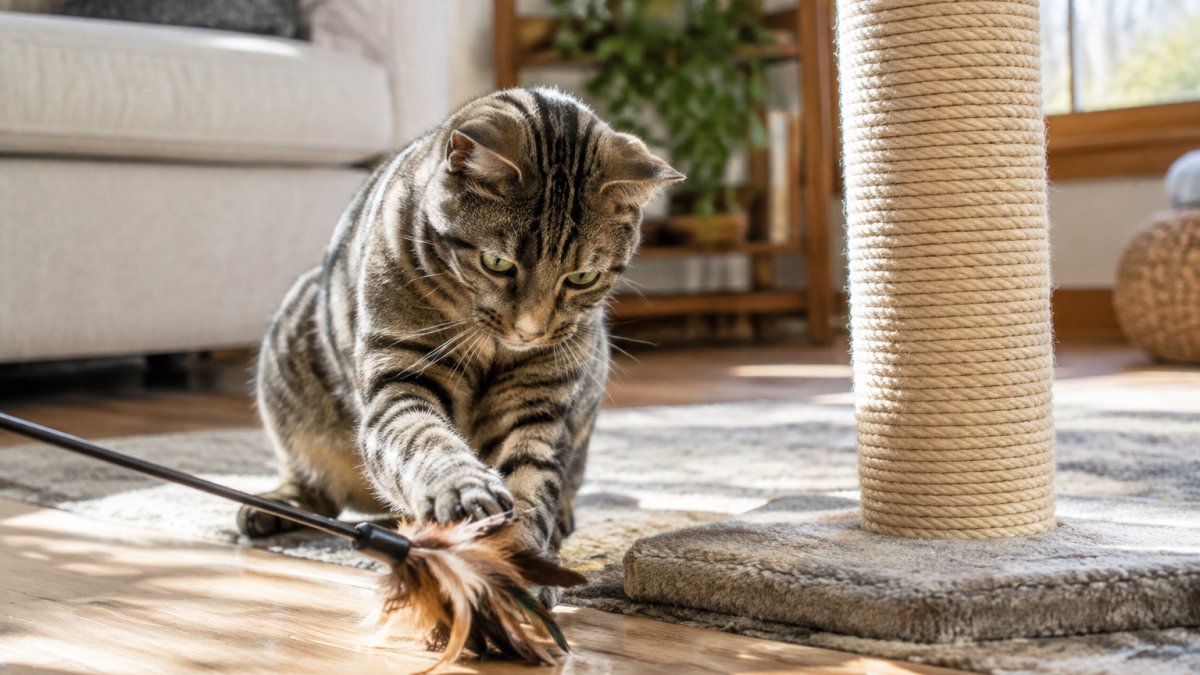
!A tabby cat batting at a feather wand toy on a sunlit living room floor beside a sturdy sisal scratching post
Look for solid bases, tightly wrapped sisal, and furniture that stays put when a cat jumps onto it. Cat trees and condos should feel stable when a cat jumps on them, because cats will test them. Beds should have washable covers and firm enough support for older cats.
Choosing Safe Toys and Replacing Worn Ones
Toys need closer inspection than furniture. Check for small parts a cat could chew off and swallow, loose strings or elastic that could wrap around a neck, and stuffing that leaks out. Replace any toy with frayed parts. Wand toys should be put away after play sessions so cats are not left alone with string.
Rotate toys every week or two. Cats lose interest in items they see constantly, and rotation keeps a small collection feeling new.
Quality differences show up most in the items cats use daily, and the article's own checks make the contrast concrete.
| Item | What to check | Why it matters |
|---|---|---|
| Scratching post | Solid base, tightly wrapped sisal | Flimsy posts stop being used within weeks |
| Cat tree or condo | Stable when a cat jumps on it | Cats will test it |
| Bed | Washable cover, firm support | Older cats need firm support |
| Toys | No small detachable parts | Cats can chew off and swallow them |
| Toys | Rotated every week or two | Constant exposure causes loss of interest |
Unique Cat Accessories Worth Considering Beyond the Basics
Beyond the standard list, a few accessories suit specific indoor lifestyles. Window perches give cats a view, which supports environmental enrichment for homes with limited outdoor access. Cat steps or nets help cats reach high places safely, especially in multi-level homes.
Organic catnip toys are another option. Catnip-filled toys appear in the enrichment research as a standard choice, and loose or organic catnip can be sprinkled on scratchers to encourage use.
Smart feeders and electronic toys can help busy households, though they require batteries and regular checks. Choose them only if you will maintain them.
How to Judge Quality Before You Buy Online
Online shoppers cannot touch a product before buying, so check details carefully. Look for these signals:
- Materials: Named materials such as solid wood, sisal rope, or stainless steel beat vague descriptions like "premium blend."
- Dimensions and weight limits: Specific measurements show whether a tree will fit your room and hold your cat.
- Care instructions: Machine-washable covers and replaceable parts add long-term value.
- Return and warranty terms: A clear policy means you can test an item at home.
- Reviews from cat owners: Look for reviews that mention durability over several months, not just first impressions.
Review counts matter less than review detail. A product with 40 detailed reviews about wear and fit tells you more than one with 400 short ratings.
Choosing a Best Online Cat Store Without Guessing
The best online cat store is the one that lets you verify what you are buying before it arrives. Here is how to tell them apart.
Selection Criteria That Actually Predict Quality
When comparing stores, look for these signals on individual product pages:
- Named materials: Solid wood, sisal rope, stainless steel, or specific fabrics beat vague descriptions like "premium blend." Named materials tell you how the item will wear and clean.
- Dimensions and weight limits: Specific measurements show whether a tree fits your room and holds your cat. A stated weight limit is a durability claim you can check against reviews.
- Care instructions: Machine-washable covers, replaceable sisal sleeves, and spare parts add years of use. A store that stocks replacement parts is signalling that the product is meant to last.
- Return and warranty terms: A clear, written policy means you can test an item at home. Vague or short return windows are a warning sign for furniture and electronics.
- Reviews that mention wear over time: Look for reviews describing how a product held up after months, not just first impressions. A product with 40 detailed reviews about wear and fit tells you more than one with 400 short ratings.
Durability, Cleaning, and Cost Per Use
Purchase price is the least useful number for accessories a cat uses daily. A cheaper scratcher that sheds its covering in weeks costs more per month than a sturdier one that lasts years. Compare items on:
- Washability: Removable, machine-washable covers for beds and furniture extend life and reduce odour.
- Repairability: Replaceable scratching surfaces, re-coverable beds, and spare parts keep an item in service instead of in landfill.
- Expected lifespan: Cat trees and scratchers should last years; wand toys and small plush toys are consumables and should be priced accordingly.
- Cost per use: Divide price by expected months of use to compare fairly. A higher upfront price often wins on this measure for furniture.
Watch out: a store that lists no materials, no dimensions, and no care instructions is not giving you enough to judge quality, treat that as a reason to look elsewhere rather than a reason to guess.
Matching the Store to Your List
Stores that carry a broad range, from food and litter to beds and toys, can simplify buying for multi-pet households. Compare a store's selection against your actual list rather than assuming one shop has everything. Dust and Iron offers clothing, home essentials, and pet supplies, so you can check its catalog for some of these categories.
Prices depend on the product, quantity, and delivery option, so check Dust and Iron's website for current prices. The store that wins is the one that gives you enough detail to predict how an accessory will perform in your home, not the one with the longest catalogue.
Building an Indoor Cat Setup That Lasts: Your Next Step
Quality accessories pay off when they are chosen for how your cat actually lives. Start with the essentials, replace worn items before they become hazards, and rotate toys to keep play interesting.
Build a setup your cat will use every day. Browse Dust and Iron's pet supplies to find sturdy toys, beds, and scratchers that suit an indoor home.
Frequently Asked Questions
What supplies does an indoor cat need?
An indoor cat needs a litter box sized for its body length, fresh water and food bowls, a bed in a quiet spot, at least one scratching surface, a few toys for play, and a carrier for vet visits. Start with the essentials and add enrichment such as a cat tree or climbing furniture as your cat shows interest. Choose items with sturdy construction, since flimsy scratchers and cheap toys tend to wear out quickly, and check that small parts cannot be chewed off and swallowed.
How do I choose safe toys for an indoor cat?
Look for toys without small detachable parts, loose strings that can be swallowed, or sharp edges. Wand toys, balls and interactive play tools that you control are a good choice because you can end play sessions and put them away. Supervise new toys at first, especially string-based ones, and replace anything that frays or breaks. Catnip-filled toys are a popular option for many cats, though not every cat responds to catnip.
Do indoor cats need a cat tree or climbing furniture?
Many indoor cats benefit from vertical space because it gives them a place to climb, perch and watch the room, which supports exercise and a sense of security. A cat tree should be stable, with a wide base and sturdy posts, so it does not tip when your cat jumps. If you have limited space, a wall shelf or a window perch can provide similar benefits for a cat that enjoys height.
How often should I replace cat toys and scratching accessories?
Check cat toys and scratchers regularly and replace them when they are shredded, loose, or missing parts. Scratching posts usually need replacing once the sisal or covering is worn down to the base, while toys should be retired when stuffing or feathers come out. Rotating toys every week or two keeps them interesting and lets you spot wear earlier.
